Pontoon Boat Cover Support: 3 Best Picks Compared (2026)
Compare 3 pontoon boat cover support systems by height range, base design and materials, plus buying tips to keep your cover tight and stable in wind.
 By Lauren Holland
Updated November 10, 2026
 By Lauren Holland
Updated November 2026
Pontoon boat cover support systems keep a cover from sagging, pooling water or collapsing under snow and wind. Choosing the right set comes down to four things: the height range you need to clear your rails and seating, the base design that will hold on your deck, the pole material and its resistance to corrosion, and how well the system handles wind load. The three options below cover those criteria across different price-conscious and durability-focused needs. Each product is described from its listing details and typical owner feedback patterns; none has been physically tested for this article.
Our top picks at a glance
- 1TOP CHOICEBest overall2 Pack Steel Boat Cover Support Pole System Adjust to 17", 30", 42" or 55"View on Amazon
- 2
 Best for corrosion resistanceAPXL Boat Cover Support Poles, 304 Stainless SteelView on Amazon
- 3
 Best budget pickBAYSTMAM Boat Cover Support Pole System AluminumView on Amazon
Our Top Picks
Quick Comparison
| Product | Best for | Key feature |
|---|---|---|
| 2 Pack Steel Boat Cover Support Pole System | Owners wanting several height settings | Four adjustable heights from 17″ to 55″ with a 9″ ABS base |
| APXL Boat Cover Support Poles, 304 Stainless Steel | Boats kept in saltwater or humid climates | 304 stainless steel poles with a full-contact heavy-duty base |
| BAYSTMAM Boat Cover Support Pole System Aluminum | Shoppers who want an all-metal, height-adjustable set | All-metal aluminum construction with height adjustment |
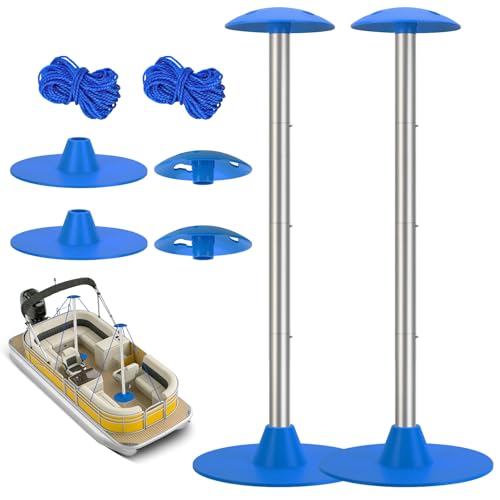
2 Pack Steel Boat Cover Support Pole System Adjust to 17″, 30″, 42″ or 55″
2 Pack Steel Boat Cover Support Pole System Adjust to 17“, 30”, 42“or 55” | Anti-UV PE Ropes & 9" ABS Base, Stable Windproof Support System- Adjustbale 1-1/8" in Diameter for V-Hull/Pontoon/Jon Boat
Best for: Owners who want the most height flexibility from one set of poles.
This two-pole kit suits pontoon owners whose covers sit over varied seating, bimini tops or rail heights, and who want to dial in the exact clearance rather than buy a fixed-height set. The listing describes a stable, windproof design intended for V-hull, pontoon and jon boats.
Key specs
- Adjustable heights of 17″, 30″, 42″ or 55″
- Pole diameter of 1-1/8″
- 9″ ABS base
- Anti-UV PE ropes
- Sold as a 2-pack
Pros
- Four preset heights cover a wide range of rail and seating layouts.
- The ABS base spreads load across a larger footprint than a narrow foot.
- Anti-UV rope helps the lines hold up under sun exposure.
Cons
- Steel poles need periodic checks for surface rust, especially at fasteners.
- The ABS base may need extra padding on fiberglass or gelcoat decks to avoid marks.
Bottom line: A strong pick for owners who expect to change cover heights or want one set that adapts to different boat layouts.
View on AmazonAPXL Boat Cover Support Poles, 304 Stainless Steel
APXL Boat Cover Support Poles, 304 Stainless Steel Boat Cover Poles, 2 PK | 2 PK Adjustable Boat Cover Poles, Stable Full-Contact Heavy-Duty Base for Boat Cover Support, Pontoon Cover Support Poles
Best for: Boats kept in saltwater air, humid marinas or year-round outdoor storage.
Owners who store their pontoon at a dock near salt spray or in a humid region usually care most about corrosion. Stainless steel is the material most often recommended for that environment, and this two-pack is built around it, with a full-contact base meant to spread load on the deck.
Key specs
- 304 stainless steel poles
- Two-pack, adjustable
- Full-contact heavy-duty base
Pros
- 304 stainless resists rust far better than painted or plated steel in wet conditions.
- The full-contact base reduces the chance of a single point pressing into the deck.
- Adjustable design makes it usable with different cover heights.
Cons
- Stainless is typically heavier than aluminum, which adds handling effort when mounting.
- Exact height increments depend on the listing; confirm them before buying if you need a specific clearance.
Bottom line: The best fit for boat owners who prioritize long-term corrosion resistance over lightweight handling.
View on AmazonBAYSTMAM Boat Cover Support Pole System Aluminum
BAYSTMAM Boat Cover Support Pole System Aluminum Made | All Metal, Height Adjustable, for Pontoon Boat
Best for: Shoppers who want an all-metal, height-adjustable set at a budget-friendly level.
This is an all-metal aluminum system aimed at owners who want adjustable support without moving into a premium stainless set. It is designed for pontoon boats and fits the general category of height-adjustable cover poles.
Key specs
- All-metal aluminum construction
- Height adjustable
- Designed for pontoon boat covers
Pros
- Aluminum is lighter than steel or stainless, which makes mounting and removal easier.
- All-metal build avoids plastic components that can crack in cold weather.
- Height adjustment lets you match the cover to your boat’s profile.
Cons
- Aluminum flexes more than stainless under heavy snow or gusty wind, so check tension often.
- Listing details on exact height ranges and base size are limited, so verify them before ordering.
Bottom line: A sensible choice for lighter use, mild climates or owners who value easy handling and a lower-cost entry point.
View on AmazonBuying Guide
Height Range and Adjustability
Measure from the deck to the highest point of your cover when it is set, including seating and any bimini or console. Most owners add 4–6 inches of clearance so the cover does not press on the top of the seats or rails. Adjustable poles, like the 17″ to 55″ range on one set listed above, save you from buying separate sizes for different layouts.
Good picks for this: 2 Pack Steel Boat Cover Support Pole System; BAYSTMAM Boat Cover Support Pole System Aluminum
Pole Material and Corrosion Resistance
Steel is strong but rusts once its coating is scratched. Aluminum does not rust but flexes more. Stainless steel, particularly 304 grade, offers the best corrosion resistance for saltwater and humid storage. Match the material to your environment rather than choosing on price alone.
Good picks for this: APXL Boat Cover Support Poles, 304 Stainless Steel; 2 Pack Steel Boat Cover Support Pole System
Base Design and Deck Protection
The base distributes the load of the pole and cover onto the deck. A wider base, such as the 9″ ABS base on one set above, reduces point pressure. Full-contact bases spread weight further still. Place a small rubber or felt pad under the base on gelcoat or painted surfaces to prevent scuffing.
Good picks for this: APXL Boat Cover Support Poles, 304 Stainless Steel; 2 Pack Steel Boat Cover Support Pole System
Wind and Snow Load
Support poles are what keep a cover from acting like a sail or collecting snow. Heavier-duty bases and stiffer poles resist movement better. In areas with frequent high winds or heavy snowfall, check tension after every storm and consider adding a third pole on wide covers, following your cover manufacturer’s guidance.
Good picks for this: APXL Boat Cover Support Poles, 304 Stainless Steel; 2 Pack Steel Boat Cover Support Pole System
Weight and Ease of Handling
If you remove and reinstall supports each season, weight matters. Aluminum is the lightest option of the three types covered here. Stainless and steel sets are heavier but more rigid. Consider how often you will handle them and whether one person can set them alone.
Good picks for this: BAYSTMAM Boat Cover Support Pole System Aluminum; APXL Boat Cover Support Poles, 304 Stainless Steel
Fit With Your Cover and Mounting Method
Confirm that the pole sleeves or receptacles match your cover’s support points. Some covers use sleeves for poles, while others use straps. Check that the pole diameter fits the sleeve; the 1-1/8″ diameter listed on one set is a useful reference point when comparing options. Covers from manufacturers that include support poles may already be sized for a specific system.
Good picks for this: 2 Pack Steel Boat Cover Support Pole System; BAYSTMAM Boat Cover Support Pole System Aluminum
Care and Long-Term Maintenance
Rinse poles with fresh water after use in salt or brackish conditions. Inspect fasteners and bases each season, look for rust or cracked plastic, and lubricate adjustment mechanisms as directed by the manufacturer. Store poles dry when the boat is out of the water if you remove them for winter.
Good picks for this: APXL Boat Cover Support Poles, 304 Stainless Steel; BAYSTMAM Boat Cover Support Pole System Aluminum
FAQ
How many support poles does a pontoon boat cover need?
Most pontoon covers use at least two poles, one near the bow and one near the stern, to hold the peak above the seating. Wider boats or covers with large bimini sections may need a third pole in the middle. Check your cover maker’s instructions, since they often specify the number and placement.
What height should I choose for cover support poles?
Measure the tallest point inside the boat, such as the top of a bimini frame or console, and add a few inches so the cover clears it. Adjustable systems let you fine-tune this, which is useful if your seating layout changes.
Is stainless steel better than aluminum for boat cover poles?
Stainless steel, especially 304 grade, resists corrosion better than aluminum in saltwater and humid conditions. Aluminum is lighter and does not rust, but it flexes more under load. The better choice depends on your storage environment and how much you value weight savings.
Can cover support poles damage my boat’s deck?
They can if the base is small or placed on bare gelcoat under load. Use a wide base, a rubber pad or a felt liner under the foot, and avoid tightening the cover so hard that it pulls the poles into the surface.
How do I stop my cover from sagging between poles?
Set the poles at the correct height, keep the cover tensioned evenly with its straps or lines, and check after heavy rain or snow. Adding a pole or adjusting the position of existing poles often solves persistent sagging.
Do I need to remove support poles in winter?
That depends on your region and cover design. Some owners leave poles in place year-round, while others remove them to reduce stress from ice and snow. Follow your cover manufacturer’s winter guidance, and dry and store poles if you take them down.
When should I consult a professional about boat cover supports?
If your boat has an unusual deck, a custom enclosure or you are unsure whether a support system will load the structure safely, consult a marine dealer or a qualified boat service technician. They can recommend placement and materials for your specific hull and cover.
Conclusion
For the widest height flexibility, the 2 Pack Steel Boat Cover Support Pole System covers the most layouts. For boats exposed to salt or humidity, the APXL Boat Cover Support Poles in 304 stainless steel are the most durable match. For a lighter, all-metal option at a budget-friendly level, the BAYSTMAM aluminum system is a practical choice. Match the pick to your storage environment, height needs and how often you will handle the poles.
Sources
- Product safety guidance on securing outdoor equipment and reducing tip and fall hazards (cpsc.gov)
- Recreational boating industry standards and owner guidance for marine equipment care
- Boating safety resources covering vessel maintenance and storage (uscg.mil)
Related reading
- Pontoon Boat Cover Support Pole Review: Features and Performance
- Winter Cover for Pontoon Boat: A Step-by-Step Guide for Beginners
- Waterproof Pontoon Boat Cover: How to Choose, Fit and Keep It Dry (2026)
About Lauren Holland
Lauren Holland is part of our editorial team and reviews and edits our houseboating guides, checking product details against manufacturer specifications and owner feedback.
About the author
Lauren Holland writes reviews and buying guides for Discover Houseboating.